


 Share:


Zhu Guangyao, former vice minister of finance of China, delivered a keynote speech at the opening ceremony of the Think Asia Forum 2026 in Singapore on Nov. 25, calling on Asia to seize the dual transformation of artificial intelligence and blockchain to shape a shared future.
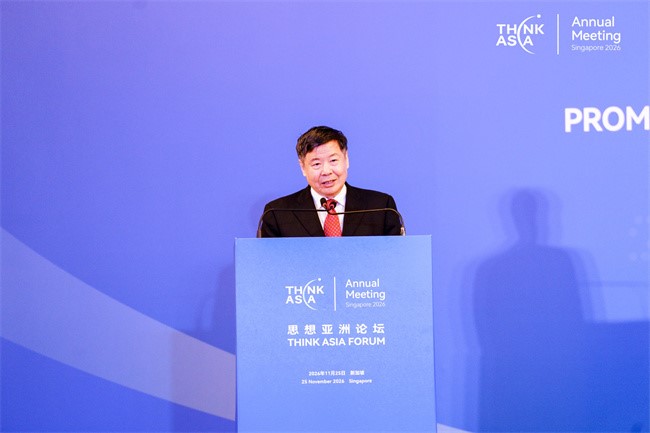
Zhu Guangyao, former vice minister of finance of China, addresses the Think Asia Forum 2026 in Singapore, Nov. 25, 2026. [Photo provided to China.org.cn]
Zhu said the world is at a critical juncture in the Fourth Industrial Revolution, driven by AI, where opportunities are within reach. The previous three industrial revolutions transformed power, energy and computing, answering the question of "how people can do things better." AI, by contrast, is actively integrating into production processes as a new factor of production, raising the question of "how things should be done and by whom." Because AI iterates by the month while legislation advances by the year, there is no time for the "technology first, rules later" approach of earlier revolutions. The watershed lies not in efficiency but in who sets the rules. Whoever can set boundaries, standards and validation for intelligent agents holds the initiative in shaping the rules of the AI era.
Moving from AI's capability to the trust required to authorize it, Zhu identified blockchain as the key. Its three features — joint maintenance by multiple parties, immutable records with full traceability, and the automatic execution of smart contracts — address the three weaknesses of AI: a tendency to hallucinate, its "black box" nature and an inability to act as a civil subject. Utilizing AI and blockchain together makes processes and results verifiable and allows responsibility to be traced back to the authorizer. Blockchain is essentially a ledger jointly managed by all parties; the more autonomous AI becomes, the more people need a ledger that cannot be tampered with, can be audited clearly and ensures accuracy.
"AI knows no borders, and rules cannot remain set separately by each country," Zhu said, describing the gap between globalized business and national rules as a governance lag rather than a technical problem. He emphasized the role of Asia in AI governance by citing three sets of data: Asia's population is about 4.55 billion, or 60% of the world total; Asia's economy accounted for nearly half of the global total in 2025 by purchasing power parity; and the International Monetary Fund forecasted 3.1% global growth and 4.8% Asian growth in 2026, with more than two-thirds of global incremental growth coming from Asia. However, Zhu noted that Asia's voice in global AI governance lags far behind: only nine of the 40 experts on the United Nations' Independent International Scientific Panel on AI are from Asia, with only two from ASEAN; and of the world's more than 7,000 languages, mainstream AI models seriously cover only a few dozen.
Zhu proposed three approaches. First, Asia should not take sides but pursue its own path, using cooperation on AI applications, standards and talent development to give the region a stronger voice in global governance. Second, it should strengthen policy coordination and rule alignment by building a channel for aligning Asia's basic rules. Third, it should build blockchain into Asia's public infrastructure, including putting cross-border certificates of origin on the chain, advancing cross-border e-commerce traceability, providing trusted confirmation for supply-chain finance, and clearing and settling labor services and remittances on the blockchain.
On China-ASEAN cooperation, Zhu said its essence lies not in "one side helping the other" but in pursuing shared development. Official data show that bilateral trade between China and ASEAN exceeded $1 trillion for the first time in 2025. China has been ASEAN's largest trading partner for 17 consecutive years, intermediate goods account for more than 60% of bilateral trade, and the value of cross-border freight transported via the China-Laos Railway has surpassed 80 billion yuan ($12 billion).
Citing the China-ASEAN Countries Artificial Intelligence Application Cooperation Center as an example, Zhu said it offers a clear model for collaboration: research and development in Beijing, Shanghai and Shenzhen; system integration in Guangxi, which borders ASEAN; and applications in ASEAN countries based on their actual needs. The center has identified 84 AI application needs across ASEAN countries, and the first batch of 14 cross-border projects is being implemented in seven ASEAN countries, Zhu said.
Looking ahead, Zhu proposed three ways to deepen cooperation: jointly building a China-ASEAN multilingual language resource repository, starting with Indonesian, Vietnamese, Thai, Lao, Burmese and Malay, to turn Asia's own languages into its own assets; launching cross-border "AI plus blockchain" projects in five areas: agricultural product traceability and quarantine mutual recognition, blockchain-based verification of RCEP certificates of origin, multimodal transportation document connectivity, trusted confirmation of supply-chain finance, and joint evidence collection and fund tracing for cross-border AI fraud; and creating two-way channels for talent exchange and standards alignment to cultivate experts who can write Asian solutions into international clauses.
Zhu also said that openness drives Asia's growth and urged three tasks: open-source technology, greater rule alignment and trust built on blockchain. Asia does not have to choose between "U.S. rules" and "EU rules," he said, but can enter the AI era with the languages, data and rights of its own developing countries. "Let AI computing power illuminate Asia's fields and ports, and let blockchain records safeguard Asia's contracts and credit. This is our solution to seizing the opportunities of the dual transformation and shaping Asia's shared future," he concluded.
The Think Asia Forum 2026 was jointly hosted by China International Communications Group, Tsinghua University, Xiamen University and Nanyang Technological University, and brought together over 150 representatives from academic institutions, think tanks and media organizations across Asia.


 京公网安备
11010802027341号
