


 Share:


Producers of China's first AI feature film "San Xing Dui" confirmed this project does not mean they will abandon developing live-action feature films, but they are exploring new approaches. This is with the hope of offering audiences something completely original, in different forms of cinematic expression, that will go on to create a new path for China's film industry.
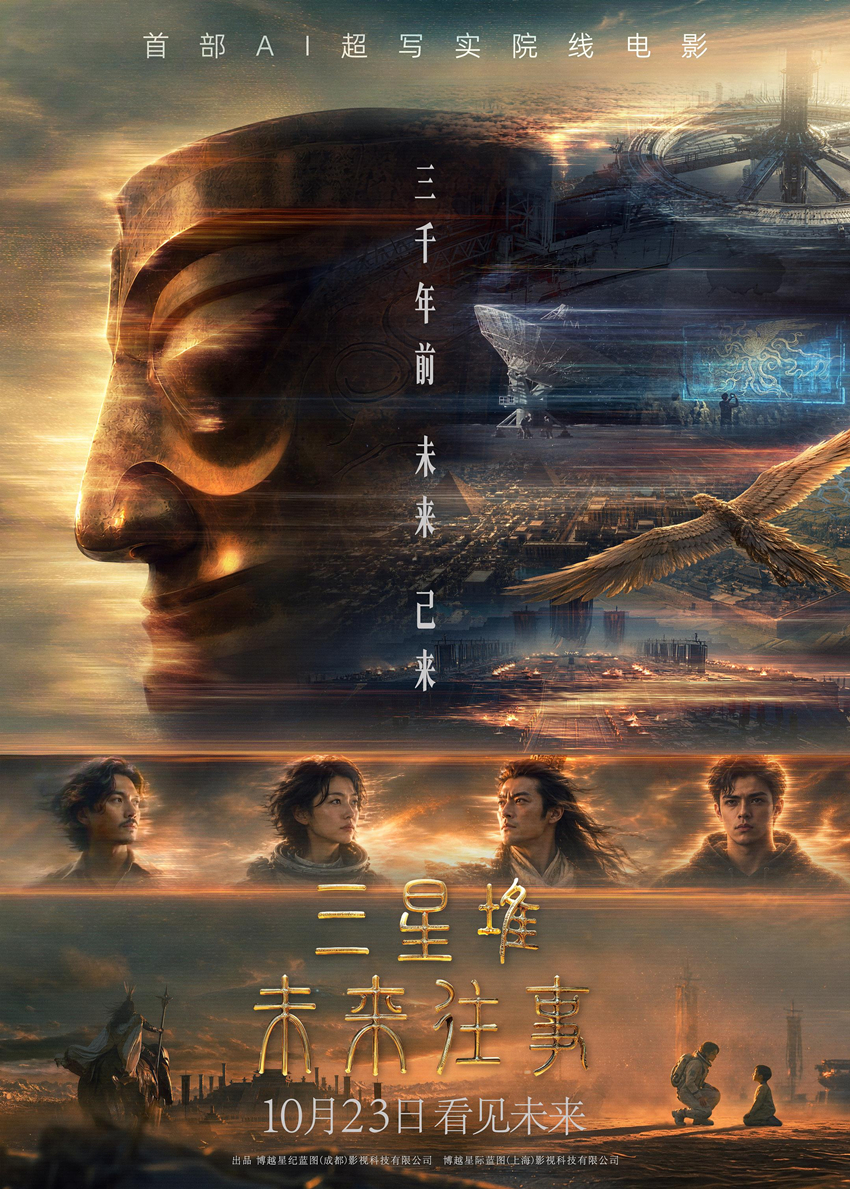
A poster for "San Xing Dui." [Image courtesy of Bona Film Group]
The 100-minute "San Xing Dui" is China's first fully AI-generated feature to obtain a release permit from the China Film Administration. It hit cinemas Oct. 23, marking the beginning of a new point in time where regulators have established a review system allowing full-process AI films into commercial theaters. This is the foundational model for future AIGC film commercialization.
Directed by Yue Ming, the film is a sci-fi thriller that draws on the mysteries of an ancient Chinese civilization in Sichuan province. It tells the story of an archaeologist who must decode seven Sanxingdui characters which is the key to saving a future world enslaved by super AI.
Quji Xiaojiang, the film's producer and deputy general manager of film and television production at Bona Film Group, explained that the story centers on a possible AI-driven future crisis. The connection is because Sanxingdui's ancient sacrificial pits were once used to seek guidance from a higher civilization. She saw a parallel with AI: across some 3,000 years, the ancient sacrifices and today's debates over artificial intelligence turn on the same question. Should humanity surrender its fate, or keep it in its own hands?
She revealed that the project began in 2022 at the invitation of the local government. They had wanted to do a live-action feature but found it too costly, with the budget soaring from 800 million to 900 million yuan (about $120 million to $135 million). It would have taken a long, complicated process with many uncontrollable factors. But this is the project they were longing to make.
In 2024 they tried producing an AI-generated short series titled "Sanxingdui: Future Apocalypse." To their surprise, it was quite successful, generating more than 200 million views online.
This strengthened their confidence, and they began thinking about making a feature film as AI continued to develop. They worked with ShengShu Technology, the company behind the video generation model Vidu. The producer stressed that making short AI videos for smartphones differs sharply from making a big-screen film, and that ShengShu's team was there to solve problems general-purpose models could not.
Jiang Defu, another producer of the film and COO of Bona Film Group, said they will not abandon live-action film production and will also try combining live-action filmmaking with AI.
He said they have long sought to solve two widely recognized problems in the film industry: funding and talent. Blockbusters now cost hundreds of millions of yuan, so caution is essential. In the past, a single major visual-effects shot could cost millions, but new technology now offers an alternative. Saving what can be saved, he believes, will go toward new projects. This will help raise both the output and quality of China's film industry.
Jiang stressed that using AI does not mean abandoning live actors, saying every craft in the traditional production chain is still needed, and that in cinematography many technical roles remain in short supply. He also noted that the company hires and trains many young people proficient in AI who love film, teaching them to think like film directors.
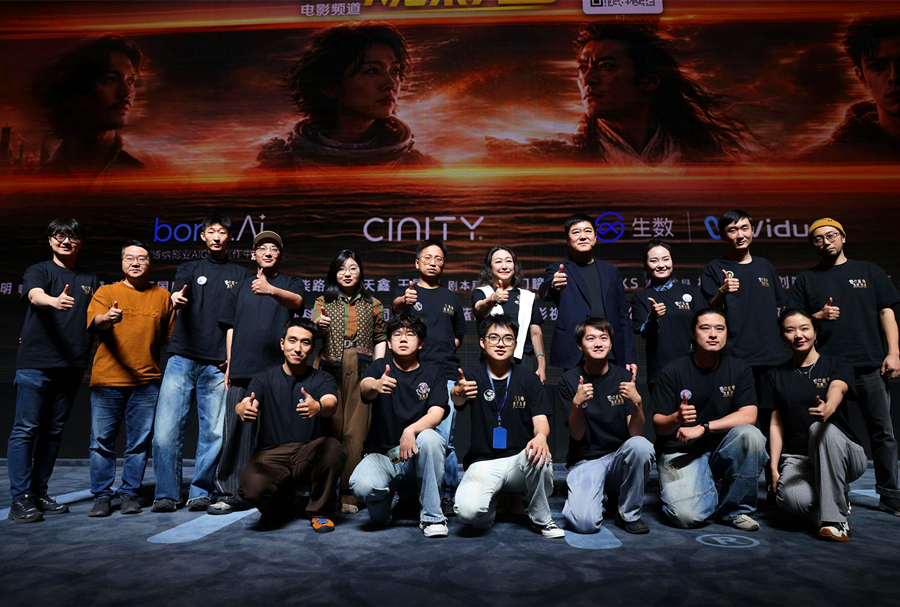
Creators of "San Xing Dui" pose for a group photo at a special screening held in Beijing, Oct. 22, 2026. [Photo courtesy of China Movie Channel]
He dismissed the idea that the film was "generated with one click," saying the team followed the film industry workflow and produced it frame by frame. He noted that AI iterates so fast that they reworked many scenes even after the film received its screening permit. There was close to 100 minor changes and five major overhauls. The project was polished over two years, generating more than 1.2 million base images through over 100 rounds of revision, all by a team of under 100 people.
The film draws inspiration from the Sanxingdui ruins site, an archaeological site in southwest China's Sichuan province. It is known for its striking bronze masks, intricate sculptures and other artifacts associated with the ancient Shu civilization. The veteran producer behind "The Battle at Lake Changjin II" and "Chinese Doctors" said spreading Chinese culture is close to his heart, and he wants to make films that traditional filmmaking cannot yet achieve.
Jiang said the film opened in Malaysia on the same day as in China, and that 14 other countries and regions are in talks about overseas releases. He hopes Sanxingdui, a treasure of Chinese culture, can gain greater recognition and spread throughout the world.


 京公网安备
11010802027341号
