


 Share:


Foreign experts visiting Chengdu, Sichuan province, from Oct. 13 to 16 explored the city's cultural heritage, technological advances and efforts to attract global talent, gaining insights into how the southwestern Chinese metropolis is strengthening its position as an innovation hub while preserving its distinctive cultural identity and quality of life.
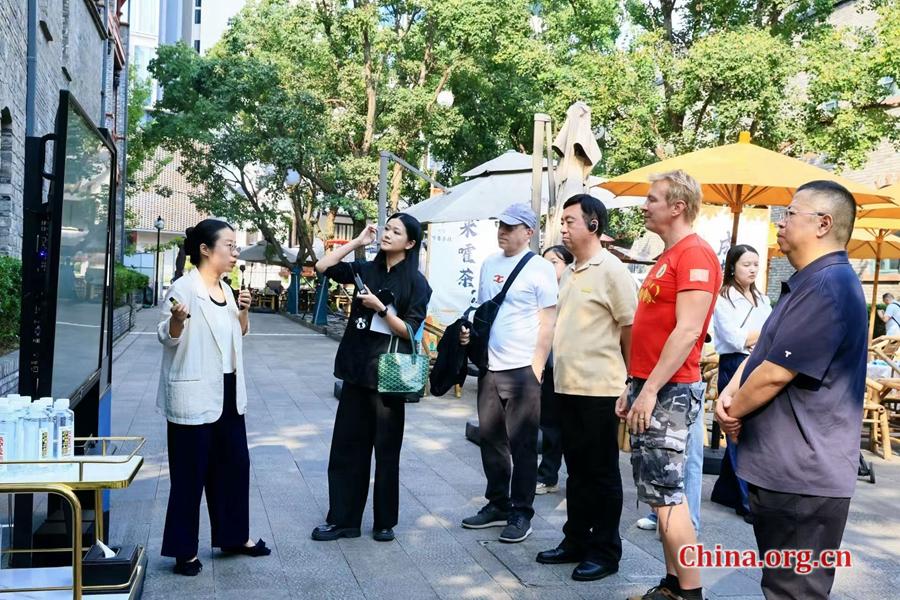
Foreign experts visit Citang Street in Chengdu, Sichuan province, Oct. 13, 2026. [Photo provided to China.org.cn]
The delegation visited the 300-year-old Citang Street, Tianfu TCM Innovation Harbor and Western Brain Valley, among other sites, to learn about the city's cultural development, emerging industries and innovation ecosystem.
At a symposium held during the visit, Zhou Hong, director of the Science and Technology Bureau of Chengdu, highlighted the city's long history and cultural heritage. Chengdu has a recorded civilization history of more than 4,000 years and a history as an urban center of more than 2,000 years, she said, adding that the city is home to the renowned Sanxingdui Ruins and Jinsha Site.
Alongside its cultural heritage, Chengdu is advancing its development as a science and technology innovation center in western China.
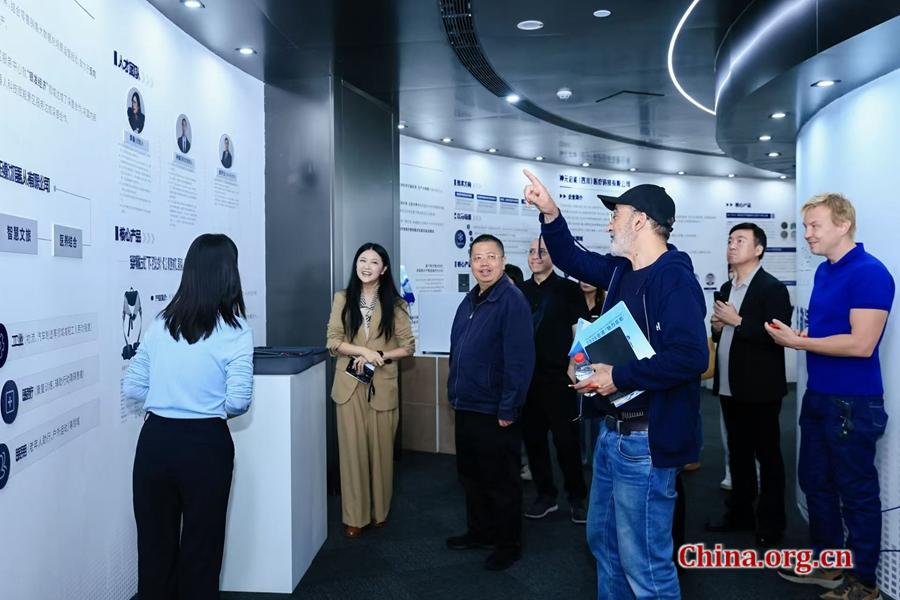
Foreign experts visit Western Brain Valley in Chengdu, Sichuan province, Oct. 15, 2026. [Photo provided to China.org.cn]
China is supporting Chengdu and Chongqing in building a science and technology innovation center. Chengdu ranked 20th in this year's Global Innovation Index's innovation cluster ranking published by the World Intellectual Property Organization (WIPO). According to Zhou, the city has also been named one of the country's best cities for attracting talent for seven consecutive years.
Ryad Chellali, a French professor specializing in robotics and AI at Nanjing Tech University, said he had witnessed Chengdu's rapid development through frequent visits over the years.
"I used to come to Chengdu very often, and recently, maybe two or three times a year. And I saw the very fast development of Chengdu," he said.
Chellali also praised the city's living environment, recalling a self-driving trip through the mountain roads around Chengdu. With its industrial base, attractive living environment and strong educational resources, he said the city has the potential to draw more talent.
Francesco Faiola, an Italian researcher at the Research Center for Eco-Environmental Sciences of the Chinese Academy of Sciences, said his second visit to Chengdu had broadened his understanding of the city beyond its reputation for pandas.
"I realized that Chengdu is not only popular for pandas. It's popular because it's a very lively city," he said, noting the number of international tourists and the city's progress in science and technology.
What impressed Faiola most was the close connection between academia and industry. This integration, he said, could help Chengdu develop into an innovation hub with influence both domestically and internationally.
Erik Nilsson, an American reporter with China Daily who first visited Sichuan in 2006 to see the pandas, was making his 19th visit to the province. He said the trip had given him an opportunity to discover a new dimension of Chengdu: its technological development.
He said he hoped his videos, articles and social media posts would help international audiences gain a better understanding of the city's growth.
Nilsson also highlighted Chengdu's livability, citing its quality of life, delicious food, friendly people and relaxed pace of life. While hot pot, spicy cuisine and pandas have long been among the city's best-known symbols, he believed that technology could increasingly become another defining feature of Chengdu and Sichuan.
Xiao Gang, a Chinese-Danish professor in the School of Material Science and Chemical Engineering at Hubei University of Technology, said he was optimistic about Chengdu's innovation potential after visiting local industrial parks, companies and universities.
Drawing on his experience in international scientific cooperation, Xiao emphasized that foreign experts can serve as bridges between China and the world, sharing firsthand observations of the country's scientific and industrial development.
Telling China's story can be achieved through real examples of scientific research and exchanges, he said, adding that technological cooperation can foster cultural understanding and help international audiences gain a more comprehensive and authentic picture of China.


 京公网安备
11010802027341号
