


 Share:

Chinese science fiction writer Wang Jinkang, a former petroleum machinery engineer who began writing sci-fi at 45, looked back on his life and creative philosophy at a Sept. 27 symposium in Beijing examining his influence on Chinese sci-fi.

Wang Jinkang [Photo/China.org.cn]
"I want to quote a line from one of my novels: Time is the harshest judge, washing away all power and glory. What survives its scrutiny — whether a love song, a short poem, a maxim or a handicraft — proves its creator did not live in vain," Wang said.
The writer, now 77, said he was introverted but intellectually sharp as a child and a top student in both the humanities and sciences. He later worked as a design engineer at a petroleum machinery factory. In the 1980s, he was a pioneer in designing heavy-duty trucks for rigs servicing oil wells.
But Wang describes himself as "developmentally unbalanced," technically gifted but socially awkward, with little interest in salaries and promotions. That solitude, he now believes, is a gift. It shielded him from distractions and preserved a childlike passion for grand questions about identity, origins and destiny.
Wang came to sci-fi by accident. At 45, he was making up bedtime stories for his 10-year-old son, who encouraged him to turn one of them into a story titled "Adam's Return" and submit it to Science Fiction World magazine.
At the symposium, held at the National Museum of Modern Chinese Literature, Wang's 21-volume collected works and manuscripts were donated to the museum. Across more than three decades, Wang has won 20 Galaxy Awards, 13 Chinese Nebula Awards and two lifetime achievement awards.
Speaking at the symposium, fellow sci-fi writer Liu Cixin said, "Wang Jinkang neither simply imitates Western sci-fi narrative models nor deliberately asserts Chineseness, but rather imagines humanity's shared future through his own real-life experience and knowledge structure."
Liu also said he belongs to a generation of sci-fi writers who grew up reading Wang's work.
Wang said Chinese sci-fi writers were marginalized in the 1990s. What kept him writing was his childhood fascination with science. Long drawn to the fundamental laws of nature, he had once wanted to become a scientist, and sci-fi became an outlet for that passion.
Wang is known for exploring the identity and ethical dilemmas of technologically transformed humans, and his work in the 1990s anticipated many questions of the AI era. According to peers, younger writers and experts in the field, his writing on genetic modification and artificial intelligence confronts real ethical dilemmas. His storytelling, characters and intellectual depth, infused with humanistic compassion and traditional Chinese philosophy, make him a leading figure in contemporary sci-fi. He also coined many sci-fi concepts, terms and settings of his own, broadening the scope of contemporary Chinese imagination and making a distinctive contribution to Chinese literature.
In 2011, he formally proposed the concept of "core sci-fi," which he refined over the following decade and which has become a guiding principle for Chinese hard sci-fi.
"Core sci-fi draws on the beauty of science itself as an aesthetic element, conveying science's own power," Wang explained. "It must be steeped in scientific rationality, with logic as self-consistent as possible and no flaws in its reasoning or knowledge, and should ideally meet the standard of 'scientific correctness.'"
For Wang, "scientific correctness" means a work's scientific premises should hold up within modern scientific knowledge and logic rather than be easily disproved. The concept rejects baseless fantasy and mythological world building.
His latest major novel, "Xing Ge San Die," was published in 2024 and won first place in the full-length novel category at the fourth Science Fiction Planet Competition during the 2026 China Science Fiction Convention. Desolate yet clear, sentimental yet not dispirited, the novel reflects on human civilization and human-machine relations.
The book grew out of a novella Wang wrote more than 20 years ago. He did not expect the change to come so quickly that he would live to see AI advance rapidly and become deeply integrated into human life.
"Sentimental yet not dispirited — this is the basic tone of all my works, from 'Adam's Return' to now. Humanity must strive, but you cannot transcend objective laws. Science has, to some extent, revived fatalism. So my writing carries a desolate and somber undertone, but it is never dispirited and always leaves room for hope," he said.
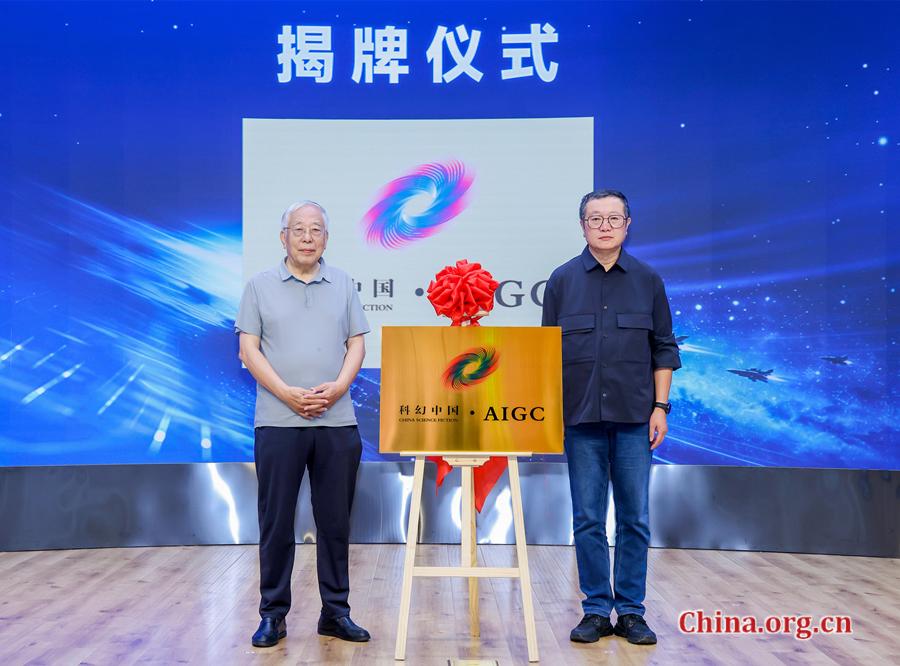
Wang Jinkang and Liu Cixin unveil a plaque for the "China Science Fiction - AIGC" audio and video production project team at a symposium in Beijing, Sept. 27, 2026. [Photo/China.org.cn]
At the symposium, the Heilongjiang Science Writers Association and the Beijing Yuanyu Science Fiction and Future Technology Research Institute launched an AI-generated content (AIGC) audio and video production project team to adapt works by sci-fi writers such as Wang. The move is expected to boost film and television adaptations of Chinese sci-fi and the growth of the country's sci-fi industry.
"Over more than 30 years, I have written 7.5 million words of sci-fi. If even two or three pieces, or one or two, can withstand the washing of time and be passed down, my life will have been worthwhile," he said.


 京公网安备
11010802027341号
京公网安备
11010802027341号