


 Share:

A launch event for an immersive sci-fi fairy-tale experience space inspired by writer Liu Cixin's "The Fire Keeper" was held in Shanghai on Sept. 29.
The project transforms the Hugo Award-winning author's literary narrative into a 1,100-square-meter experience space housed at the Shanghai Science and Technology Museum. It comprises an art exhibition covering more than 600 square meters, a virtual reality (VR) LBE area of more than 500 square meters and a cultural and creative space. It integrates ultra-high-definition audiovisual, real-time rendering, spatial computing and wireless communication technologies.

Liu Cixin speaks at a press event for "The Fire Keeper" immersive experience space at the Shanghai Science and Technology Museum in Shanghai, Sept. 29, 2026. [Photo/China.org.cn]
According to the organizers, the art exhibition officially opens on Oct. 1, followed by the launch of the VR location-based entertainment (LBE) experience on Oct. 15.
Written in late 2011, "The Fire Keeper" is Liu's only standalone fairy tale. It follows a young man named Sasha, who travels to the Far East Island to help an old fire keeper repair the stars. Together, they build a rocket from whale bones and use whale oil as fuel, flying to the moon to polish the star of his seriously ill lover Bing'er and light the sun of a new day, a mission Sasha ultimately inherits. The story is a reflection on such topics as love, sacrifice and responsibility.
"'The Fire Keeper' is a science fiction fairy tale I created after 'The Three-Body Problem,'" Liu said. "It's a simple story, but it shows a kind of understanding I have of the charm of science fiction: it can make the world we have grown accustomed to become strange again."
As Liu explained, the sun rising every day is the most natural thing. In the story, the fire keeper must participate in this process day after day. "This is also what my works often want to explore: what role do humans play in the cosmic order?"
Speaking at the launch event, Liu noted that creating a fairy tale differs from traditional science fiction, as one's imagination can be freer. "But at the same time, I still strive to create a logically self-consistent world when writing," he said.
A new edition of the picture book is published by Yilin Press, along with the immersive experience space. "Novelists use words to write, which naturally leaves the largest space for imagination," Liu said. "Painting gives this world a concrete form for the first time; virtual reality changes the relationship between people and this world — building a world with space and scale that people can enter."
Addressing the relationship between science and imagination, Liu said there is a common misunderstanding that scientific content in science fiction limits imagination. "Actually, it is quite the opposite."
He said the imaginative resources contained in science and technology are far greater than those we usually consider imaginative, including ancient mythology and modern fairy tales.
He added that the underlying laws and operating rules of the world revealed by science have far exceeded what people ever imagined, noting that the imagination contained in frontier physics and cosmology theories is astonishing but confined within mathematical formulas and models. "We need to use literature to liberate it and show it to everyone."
On adapting his work for VR, Liu said sci-fi literature, including "The Fire Keeper," may be better suited for visual expression and complex scenes rather than words.
"Modern technology, including VR, can express the imagined world very well. Especially VR, which compared to two-dimensional pictures, has an immersive scene and an immersive structure, allowing people to directly place themselves in that world — something never possible before," he said.
Liu acknowledged that VR adaptations of literary works may face difficulties not previously encountered, such as how to ensure viewers — who are free to look around — focus on the plot. "But I believe that with the development of VR technology, the artistic aspect will gradually mature," he said.
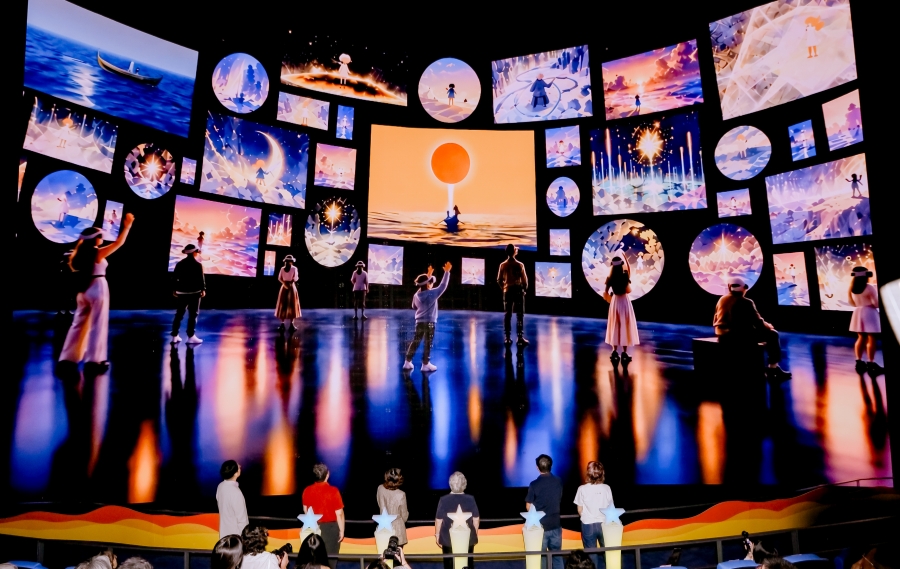
The creators of "The Fire Keeper" VR film take part in a launch ceremony for the film at the Shanghai Science and Technology Museum in Shanghai, Sept. 29, 2026. [Photo/China.org.cn]
For the Shanghai Science and Technology Museum, "The Fire Keeper" immersive experience space marks the museum's first project planned with science fiction as a major theme. Rather than simply moving a sci-fi work into a museum, the project uses the work's own imagination as a starting point, bringing together creators from science fiction, art, science education, film and television, and VR development to build the world together. For example, musician Gong Linna has provided music and vocals that enrich the work's auditory dimension, allowing visitors to perceive the emotions and imagination in the text in a new way.
"'The Fire Keeper' has a grand and complete worldview, presenting a world in which humans participate in nature — humans light the sun, and humans own their own stars. It's highly suited to an immersive medium like VR," Ji Shaoting, a producer and director of "The Fire Keeper" VR film, and founder and CEO of Future Affairs Administration, a Chinese sci-fi culture company, told China.org.cn.
The installation will run at the museum through August 2027.


 京公网安备
11010802027341号
京公网安备
11010802027341号