


 Share:

Josh Selig has spent more than three decades building bridges — not the steel-and-concrete kind, but the cultural kind. As founder and president of global IP firm China Bridge Content, he has produced animated shows that aired on both sides of the Pacific, including "Super Wings" and "P. King Duckling."
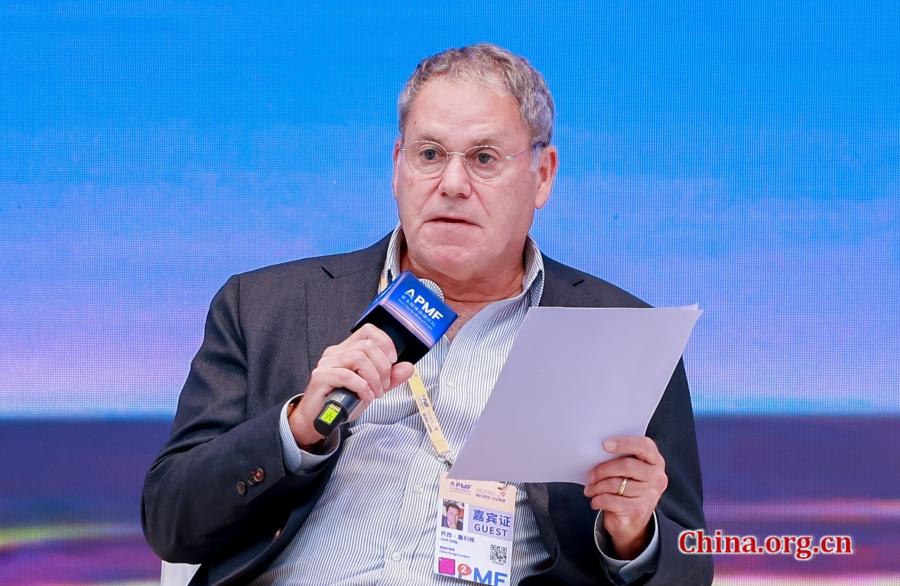
Josh Selig, founder and president of global IP firm China Bridge Content, speaks during the Asia-Pacific Media Forum in Shenzhen, Guangdong province, Sept. 5, 2026. [Photo/China.org.cn]
"I love China. I love America. There, I said it," Selig said during the Asia-Pacific Media Forum held on Saturday in Shenzhen, Guangdong province.
The animation industry veteran, who has traveled between China and the United States about 50 times over the past 30 years, said many Americans misunderstand China. "The only people I know who don't love China are those who have never been to China. They tend to repeat the same tired, old misconceptions about China. I try not to get into arguments with them."
Instead, he tells them about the China he knows. His first trips came in the 1990s, when he was part of the team that produced "Zhima Jie," the China-U.S. co-production of "Sesame Street." In recent years, he has returned dozens of times to produce new animated shows with Chinese partners. Both "Super Wings" and "P. King Duckling" found significant global success, he said, setting precedents for original Chinese IP airing in North America and other international markets.
Selig said China is making a great impact on the world through hard work, technological innovation and good relationships with nations everywhere. As an animation professional, he has been especially struck by the rise of Chinese IP. He said the animation industry in China has never been stronger, pointing to the box-office success of the "Ne Zha" films, the global phenomenon of the game "Black Myth: Wukong" and the international popularity of toy brands such as Pop Mart and its Labubu series.
He named his company China Bridge Content because he works to bridge the Chinese and U.S. media and content industries. This year's forum, a media exchange held under the APEC framework, is themed "Building a Path to Shared Prosperity for the Asia-Pacific Community: Media Consensus and Action," which mirrors what he has been doing. Selig said such gatherings provide valuable platforms for dialogue and that events like APEC meetings bring the community of nations closer together.
"The China I know is a place of fairness and reciprocity," Selig said. "In business, you often hear the phrase, 'win-win relationships,' and I have seen this approach in action hundreds of times on our TV projects."
"The China I know likes America and hopes to rebuild a mutually beneficial, lasting relationship," Selig added. "After all, we are old friends."
Selig said that when some Americans call him naive, he politely tells them they are wrong. "I suggest that they just need to get to know Chinese history better. If they did, they would see that China is a peaceful nation that strives to build good and lasting relationships."
On his animation projects, Selig said teams had to overcome cultural barriers, creative differences and workflow obstacles. "There were sleepy calls that went late into the night and, when necessary, there were last-minute flights arranged to meet face-to-face."
His company is working on animated co-productions with Chinese, U.S. and European partners to bring original Chinese IP to international markets. He said animation offers ample opportunity for cooperation, describing it as a professional and enthusiastic industry.
Selig said both sides learned that to achieve their goals, they needed to build bridges: bridges of listening, understanding and compromise. "We had to get to know one another in meaningful ways. We took walks. We met each other's families. We laughed. Only by becoming friends could we build the kind of real, lasting trust that would sustain us all through the long, difficult years of animation production."
Selig said a similar approach is needed to help the two countries overcome larger challenges. "We need to build more bridges. And not just one or two. We need hundreds. We need thousands. These bridges can take many forms: sending a brief WeChat message. Going out for coffee. Discussing a new business idea. Or giving a small gift."
For 50 years, he said, the two nations have benefited from open communication, trade, technology and student exchanges. "There is still so much more we can do together. Working together, I am quite certain our two great countries can build a safer and more equitable world."
Selig said the world's two superpowers have a responsibility to lead together. "Someone once told me, 'Partnership is difficult, but it is more honorable than dominance.' I believe that's true."
His hope, he said, is that the two nations can engage in more honest exchanges "as partners and as friends, as two powerful countries guided by the basic principles of reciprocity, fairness, equality and mutual respect."
"China is strong. America is strong. And this is a good thing," Selig concluded. "Because as every child knows, the key to building a strong bridge is having two strong bodies of land on either side. So, let's build some bridges together."


 京公网安备
11010802027341号
京公网安备
11010802027341号