


 Share:

The Lancang-Mekong River has connected the people of its basin for centuries, carrying not only water but also shared histories, traditions and cultural memories.
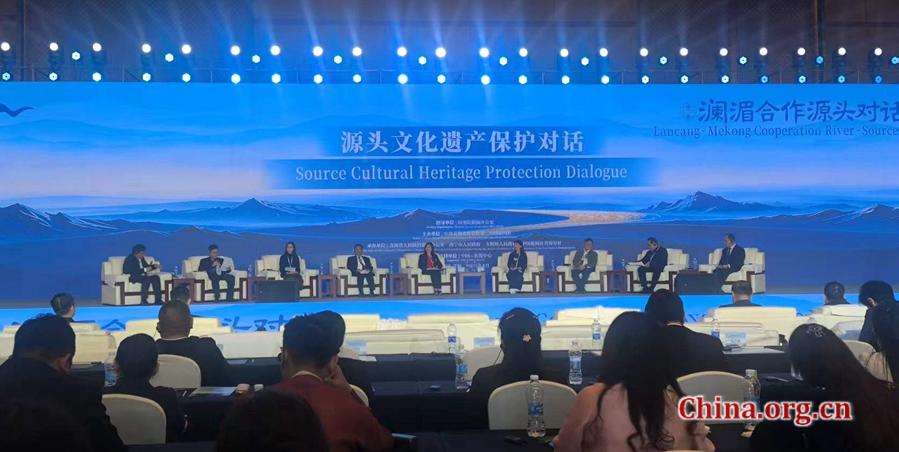
Guests share insights at the Source Cultural Heritage Protection Dialogue, part of the Lancang-Mekong Cooperation River-Source Dialogue, in Xining, northwest China's Qinghai province, Aug. 29, 2026. [Photo by Xu Xiaoxuan/China.org.cn]
Representatives from China, Myanmar, Laos, Thailand, Cambodia and Vietnam gathered in Xining, northwest China's Qinghai province, on Aug. 29 for the Lancang-Mekong Cooperation (LMC) River-Source Dialogue.
The event, held as the LMC mechanism marks its 10th anniversary this year, focused on strengthening cultural heritage protection, promoting cultural exchanges and enhancing mutual understanding among the six countries.
The Mekong River, known as the Lancang River in China, originates in Qinghai and flows through the six countries, linking communities with diverse cultures and traditions along its course.
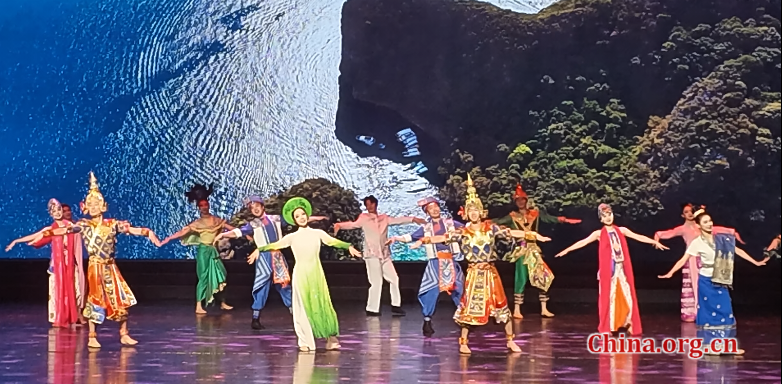
Performers dressed in traditional attire of the six Lancang-Mekong nations perform at the opening ceremony of the Lancang-Mekong Cooperation River-Source Dialogue in Xining, northwest China's Qinghai province, Aug. 28, 2026. [Photo by Xu Xiaoxuan/China.org.cn]
Participants at the dialogue emphasized that the shared river provides not only a geographical connection but also a cultural bond that transcends national borders.
Tassanee Kiatkamchornchai, vice president of the Thai Travel Agents Association, said the river takes on different names, landscapes and characteristics as it flows from China to Vietnam, but continues to connect the lives and cultures of people along its banks.
"Political boundaries may mark the end of one country's territory and the beginning of another, but cultural exchanges do not work that way," she said.
"Since cultural heritage is shared across borders, its protection must also transcend borders," she added.
Tassanee called for cooperation not only at the government level but also among cultural practitioners and tourism professionals, allowing them to visit each other's countries, learn from one another and share knowledge and experience.
Her call for cross-border cooperation was echoed by Myanmar, where efforts to protect a rich and diverse cultural heritage have increasingly benefited from international collaboration.
Aung Aung Kyaw, director general of the Archaeology and National Museum Department of the Ministry of Culture and Tourism in Myanmar, said the country has a rich array of tangible and intangible cultural heritage.
While Myanmar is working to ensure the long-term preservation of its heritage and promote heritage-based tourism, it continues to face various challenges, he said.
"We sincerely look forward to deepening cooperation with China and other Lancang-Mekong countries in jointly protecting both tangible and intangible cultural heritage," Aung Aung Kyaw said.
He noted that Chinese experts have worked closely with their Myanmar counterparts since 2018 on the restoration and archaeological work at the Thatbyinnyu Pagoda in Myanmar.
Beyond the physical preservation of heritage sites, participants also highlighted the role of film, images and digital media in recording and transmitting cultural memories.
Boonsong Phimmasone, director general of the Tourism Marketing and Promotion Department of the Ministry of Culture and Tourism in Laos, said film can help preserve cultural heritage while documenting people's lives and social changes.
He expressed hope that Laos' film industry will continue to develop and produce more high-quality local works, while deepening cooperation with other countries in film and television, cultural tourism and cultural preservation.
Cambodia also sees visual storytelling as an important form of cultural diplomacy.
Keo Kann Virak, deputy state secretary of the Ministry of Culture and Fine Arts of Cambodia, said initiatives such as the Lancang-Mekong International Video & Photography Week can make a meaningful contribution to documenting, sharing and passing on the region's shared cultural heritage.
Cambodia supports deeper cooperation in digital cultural content, audio-visual production and the exchange of professional expertise and skills, Keo Kann Virak added.
As cultural exchange increasingly moves into the digital era, media is also becoming akey channel for helping people understand one another.
Dang Thi Khanh Hoa, director of the Press Division of the International Cooperation Department of Vietnam's Ministry of Culture, Sports and Tourism, said media is playing an increasingly important role in promoting mutual understanding among countries and communities, especially through new media.
She proposed shifting from national stories to regional stories through new media, drawing on shared experiences while fostering understanding across cultural differences.
Participants also called for more innovative forms of cooperation to give the region's shared heritage a broader platform.
Shen Yang, former deputy chief engineer of the Chinese Academy of Cultural Heritage, suggested that the six countries explore joint nominations for UNESCO World Heritage status as a way to promote broader and more diverse cultural exchanges and encourage greater public participation in heritage protection and management.
The countries could also conduct joint, multidisciplinary research on their historical cultures, tangible and intangible cultural heritage and natural landscapes, laying the groundwork for future joint nominations, he said.


 京公网安备
11010802027341号
京公网安备
11010802027341号