


 Share:

A new collection of Chinese sci-fi stories inspired by the 24 solar terms has been released by China Science and Technology Press, featuring works by two-dozen prominent sci-fi writers across three generations.
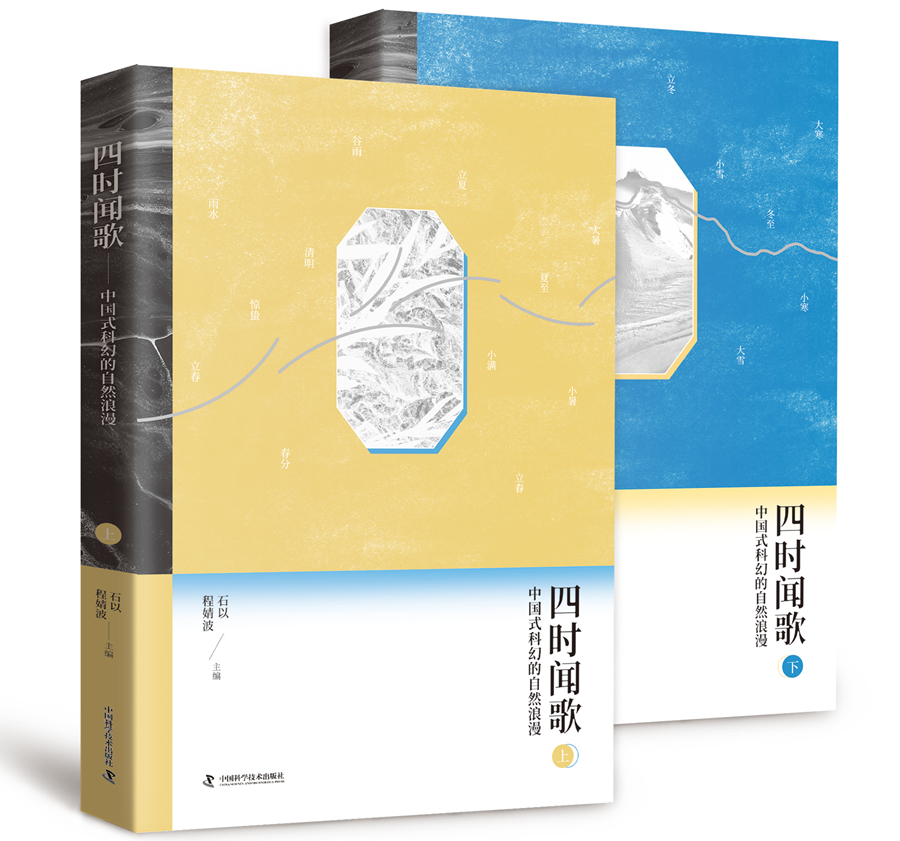
A mock-up of the book "Songs Heard in the Solar Terms: The Natural Romance of Chinese Science Fiction." [Image courtesy of China Science and Technology Press]
"Songs Heard in the Solar Terms: The Natural Romance of Chinese Science Fiction" is co-edited by chief editors Shi Yi and Cheng Jingbo, who previously collaborated on the 2024 collection "The Mountain, the Pine and the Moon: 56 Chinese Science Fiction Writers' Fantasies of Their Hometowns." The new two-volume anthology includes stories from writers such as Chao Xia, Ling Chen, Baoshu, Wang Jinkang, He Xi, Cheng Jingbo, Chen Qiufan, Jiang Bo and Han Song, spanning the Chinese mainland, Hong Kong, Macao and Taiwan.
The 24 solar terms, recognized by UNESCO as an intangible cultural heritage, are an ancient timekeeping system based on the sun's annual motion. The system divides the ecliptic into 24 segments to track seasonal and agricultural rhythms and has been passed down for more than 2,000 years.
Each writer in the anthology contributed a story for one seasonal node, exploring the traditional calendar's thousand-year-old wisdom through science fiction. Chief editor Shi Yi explained that the collection weaves ecological themes throughout, explores the cosmic codes behind the changing seasons, and paints a portrait of solar-term culture where scientific inquiry and poetic sensibility converge.
Shi said the collection could only have been born in China and written by Chinese sci-fi writers, as it is rooted in the cultural matrix of the solar terms. The two-dozen stories reinterpret the meanings of solar-term culture through sci-fi perspectives, reflecting on China's intangible heritage while offering a forward-looking vision of a shared future for humanity.
"The collection aims to use Chinese sci-fi storytelling to share with the world tales of time and life, and to construct a higher-dimensional vision of solar-term civilization," he said.
Chief editor Cheng Jingbo described the book as "like peering through a science fiction kaleidoscope," with 24 distinct voices and worldviews. "Each solar term is a revolving door, opening onto a wholly unfamiliar world of time and space," she said.
The editors said the collection demonstrates a self-aware innovation in Chinese science fiction, following on from their previous book "The Mountain, the Pine and the Moon." Unlike Western sci-fi, which often creates distant worlds to alienate people from reality, this collection re-illuminates familiar traditions — homelands and seasonal rhythms — through a futuristic lens, treating cultural heritage as a starting point for imagining the future and offering a unique Eastern vision for global sci-fi.


 京公网安备
11010802027341号
京公网安备
11010802027341号