


 Share:

Few expected that "Dear You" would become one of China's biggest breakout movies of 2026. Made for just 14 million yuan, spoken largely in the Chaoshan, or Teochew, dialect, and featuring no bankable stars, the film opened on April 30 with only 1.6% of available screenings. Strong word of mouth gradually expanded its share of screenings and pushed its total box office on the Chinese mainland past 2 billion yuan (about $296 million) by the end of July.
But why has a story about letters from another age resonated so strongly in a world of instant messages and digital payments?
The answer may lie in what these letters carried: news and money, obligations and kindness, and enduring ties to family, hometown and country. Known as "qiaopi" (侨批), they were far more than ordinary correspondence.
"Qiao" (侨) refers here to Chinese people living overseas, while "pi" (批) means a letter in the Chaoshan and southern Fujian dialects. Also known as "yinxin," or "money letters," qiaopi combined correspondence with remittances, often in the same envelope. A sender might report being safe, ask after relatives and explain how the money should be used. The message reassured the family; the funds sustained daily life.
From the 19th century onward, many people from Guangdong and Fujian provinces traveled overseas, particularly to Southeast Asia, in search of work. Qiaopi passed through remittance firms, agents and couriers; some migrants relied on letter writers. Qiaopi connected Chinese families and reinforced a shared sense of origin and belonging.

A reconstructed qiaopi remittance bureau modeled on a scene from "Dear You" at the Overseas Chinese History Museum of China in Beijing, July 23, 2026. [Photo by Wang Yiming/China.org.cn]
The Chinese character xin (信) offers another way to understand their meaning. Xin can mean a letter, but it is also associated with trustworthiness and keeping one's word. Qiaopi were thus not merely messages sent home, but tangible evidence that words had been honored.
The film develops this idea through xinyi (信义), a Chinese ethic of valuing human bonds, honoring commitments and helping others in hardship. Here, xinyi is not a transaction undertaken for repayment. It is the instinctive belief not to stand aside when a relative, friend, fellow villager or compatriot is in need.
In the film, Zheng Musheng leaves Chaoshan for Thailand to make a living, while his wife, Ye Shurou, remains in China with their children. There, he befriends Xie Nanzhi, a woman of Chaoshan descent, and risks his life to rescue her and her father from a fire. After Zheng later dies, Xie carries that kindness forward: She continues writing letters and sending money to Ye in his name for 18 years.
Without spectacle or overt sentimentality, the film lets xinyi emerge through modest details: another letter written, another remittance sent and a family she has never met quietly sustained. Through these acts, kindness, loyalty and mutual care are made tangible.
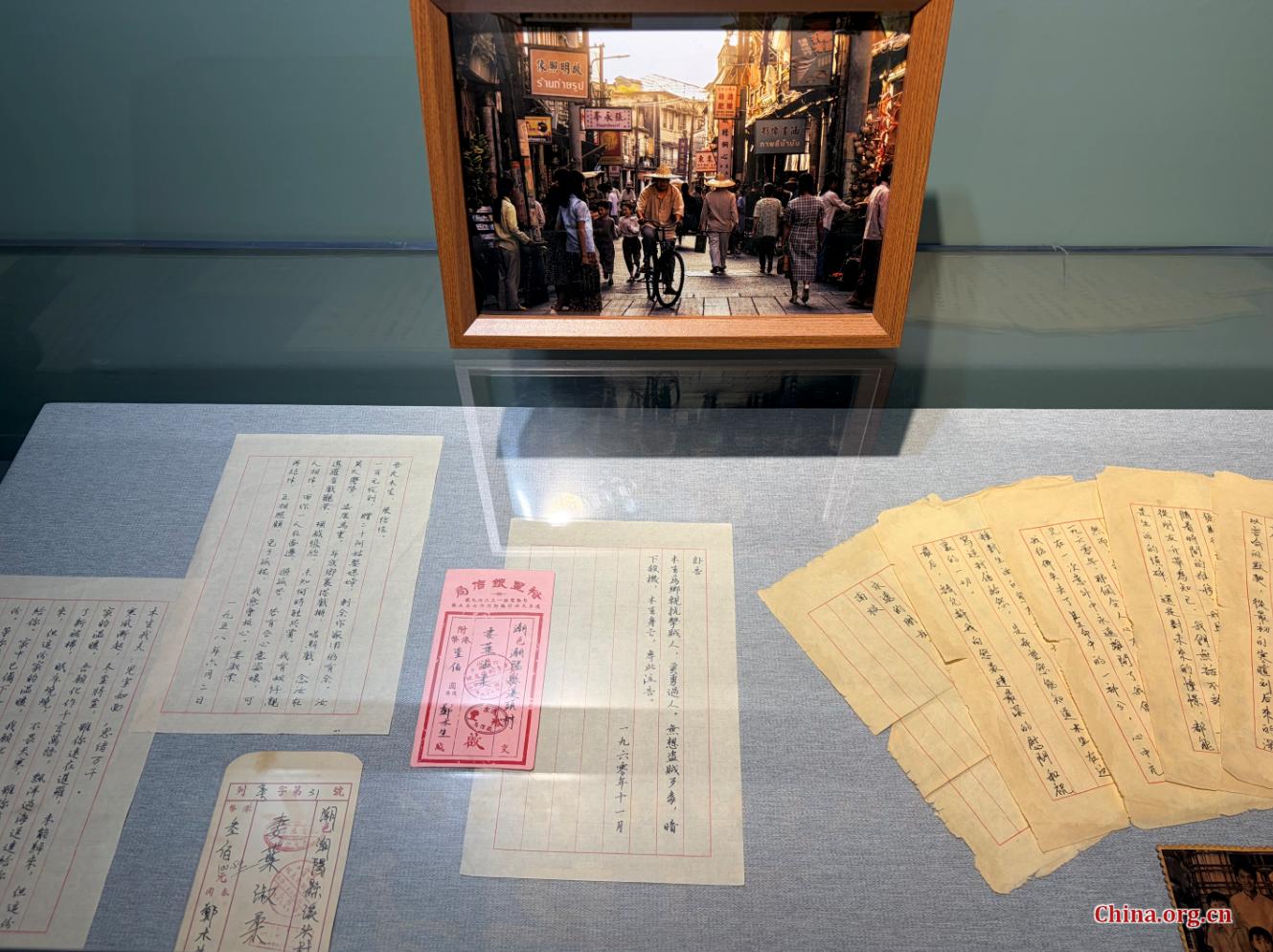
Prop qiaopi letters from "Dear You" on display at the Overseas Chinese History Museum of China in Beijing, July 23, 2026. [Photo by Wang Yiming/China.org.cn]
Nor were the bonds recorded in qiaopi confined to individual families. Qiaopi were material carriers of an ethic deeply rooted in overseas Chinese communities: cherishing human bonds and readily coming to one another's aid in times of hardship. That ethic could extend from family to fellow townspeople, native place and country.
Among the authentic qiaopi shown at the end of the film is one sent by Xu Zepu, an overseas Chinese living in Thailand. Along with the letter, he sent 100 Hong Kong dollars to support the front line. The envelope bore the words "Resist U.S. Aggression and Aid Korea, Defend the Homeland."
In later decades, remittances also supported livelihoods and public projects. Since reform and openingup, overseas Chinese have continued contributing to their hometowns and China's modernization.
The archives include letters, reports, account books and remittance receipts documenting overseas Chinese life, migration and cross-cultural contact between East and West. Inscribed on UNESCO's Memory of the World Register in 2013, the qiaopi and yinxin archives are not only records of hardship and struggle, but documentary evidence of how migrants maintained cultural identity and belonging across distance.
The film's overseas journey gives this history a contemporary echo. Since mid-June, the moviehas been released in Singapore, Malaysia and Brunei, before expanding to Australia, New Zealand, the United Kingdom, Ireland and Japan. Its Southeast Asian rollout is continuing: after premiering in Manila on July 30, it is due to open in Thailand on Aug. 6 and in the Philippines on Aug. 12.
Qiaopi once traveled from overseas communities to families in southern China. Now the film is following many of those routes in reverse, carrying their stories back to descendants of the people who once wrote them. For some viewers, it evokes grandparents' voices, ancestral hometowns and values passed quietly from one generation to the next.
Messages now arrive instantly, and money can cross borders in seconds. But no technology can replace the human choice to remember, to care and to keep faith across distance. Qiaopi are not only records of separation, but expressions of xinyi, the Chinese ideal of honoring human bonds, fulfilling one's responsibilities and standing by others in times of need. They show how affection, loyalty and mutual care can bind people together across generations and oceans.


 京公网安备
11010802027341号
京公网安备
11010802027341号