 Share:


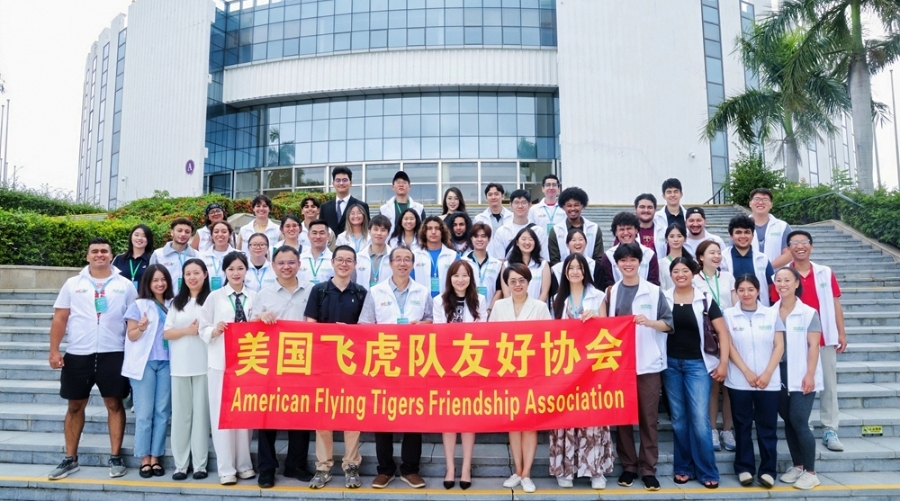
In late July, a youth delegation brought together by the American Flying Tigers Friendship Association, comprising 36 young professionals and students from universities across the United States, arrived in Hainan province for a seven-day visit.
They visited universities and technology hubs, explored villages and rainforests, learned about local traditions, and shared meals, songs and stories with their Chinese peers.
Their trip offered more than a glimpse of a rapidly developing Hainan. It also became an opportunity to revisit a wartime friendship forged 85 years ago and to consider what that legacy means to young people today.
The delegation's journey began at Hainan University in Haikou city, where an opening ceremony marked the 85th anniversary of the Flying Tigers. The institution also has a special connection to that history. Anna Chennault, widely known in China as Chen Xiangmei, was once honorary president of Hainan University. A journalist and social activist, she was the wife of Flying Tigers commander Major General Claire Lee Chennault. Her father was from Hainan, giving her a personal connection to the island.
For Charlie Xu, president of the American Flying Tigers Friendship Association, that history remains deeply relevant.
Eighty-five years ago, young American pilots traveled thousands of miles to China and fought alongside the Chinese people against Japanese aggression, he noted. Their experience showed that friendship could grow across national borders even in the most difficult of circumstances.
"The history of the Flying Tigers tells us that peace is hard-won and needs to be jointly safeguarded," Xu said, encouraging young people from both countries to carry forward the friendship established by their predecessors.

Lauren Peng Lu, a student at the University of Southern California, speaks at the launch ceremony of the trip at Hainan University in Haikou, Hainan province. [Photo provided to China.org.cn]
Among the American participants was Lauren Peng Lu, a student at the University of Southern California and a descendant of Flying Tigers veteran Lu Maoyin.
Preparing for the trip, she went through old newspapers, family archives and interview records about her grandfather.
Lu Maoyin's journey had taken him from a young military student in China to a pilot trained in the United States and eventually a member of the Flying Tigers. In 1941, he was one of only 16 men selected from about 2,000 army personnel stationed in Guilin who applied for air force service. The following year, he was sent to an advanced flight school in Phoenix, Arizona, where he completed intensive flight and combat training.
After returning to China in 1944, he was assigned to the Fourteenth Air Force, became a member of the 5th Group of the Chinese-American Composite Wing and took part in numerous combat missions.
According to Lu's recollections published online, one of the battles he remembered most vividly was a series of attacks on the Japanese airfield at Bailuoji in Hubei province in 1945. Some 300 Japanese aircraft were stationed there and used the airfield to conduct bombing raids on Chongqing, Chengdu and Kunming. Flying Tigers aircraft mounted repeated attacks on the airfield. In the first raid, some aircraft served as decoys while others launched a surprise attack from Zhijiang Airport. Lu and other Flying Tigers pilots, waiting above the clouds, swooped down as Japanese aircraft returned to the airfield, hitting planes and ground installations and setting the airfield ablaze.
Decades later, the memory of that generation traveled with his granddaughter to Hainan.
"His story reminds us that courage, sacrifice and cooperation can transcend time and background and connect people," Lauren said.
That connection was not confined to history lessons.
During the seven-day trip, the American visitors traveled to Haikou, Lingshui, Wuzhishan, Sanya and Baoting. They visited the Hainan Science and Technology Museum, explored the Lingshui Li'an International Education Innovation Pilot Zone, and learned about deep-sea research and other emerging technologies at the Sanya Yazhou Bay Science and Technology City.
They also encountered another side of Hainan — one that is typically not shown in textbooks.
They tried traditional crafts, walked through historic arcades in Haikou, visited villages, experienced the cultures of the Li and Miao ethnic groups and sampled local food. In Wuzhishan, the young Americans and their Chinese peers gathered in the Tongshi 1988 Retro District, singing and dancing together.

Delegation members sing with local performers during their visit at the Tongshi 1988 Retro District in Wuzhishan, Hainan province. [Photo provided to China.org.cn]
American participant Lily October Yang marveled at the contrast between the island's pristine rainforests and its modern technological facilities.
"Seven days is far too short to see everything in Hainan," she said, adding that she hoped to return and explore the island more deeply.
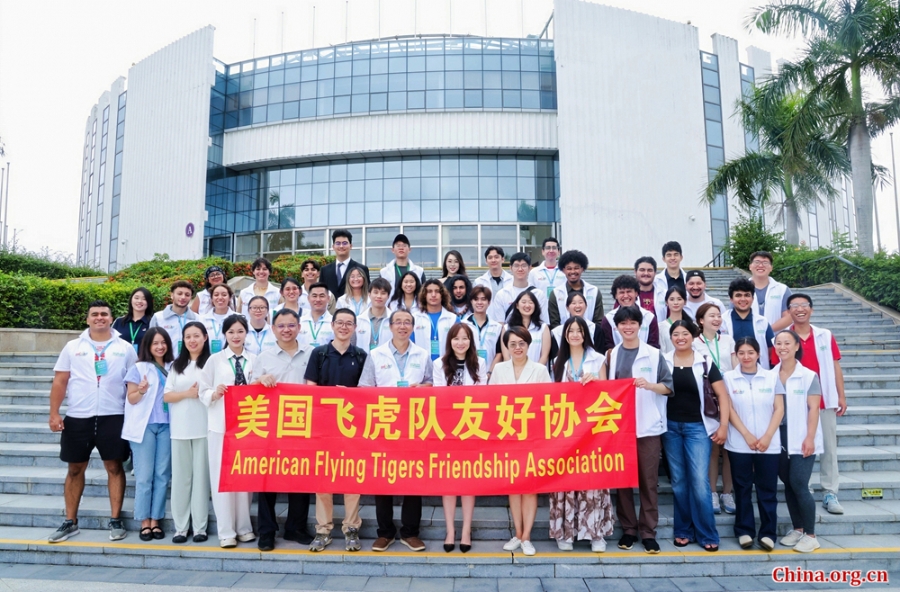
Delegation members pose for a group photo following the event's closing ceremony in Sanya, Hainan province. [Photo provided to China.org.cn]
At the closing ceremony, Chinese and American participants sang "Auld Lang Syne" and the "Moon Represents My Heart" together in Chinese and English.
Eighty-five years ago, friendship crossed the Pacific amid war. Today, it is crossing the same ocean through young people, science, culture and human connection. The Flying Tigers' story belongs to history, while the friendship they came to symbolize is still being written.


 京公网安备
11010802027341号